
Quick summary
Losing weight as a busy professional only works when training, nutrition, and behavior change are addressed together. If you focus only on the number on the scale, you miss the bigger picture: improving body composition delivers more sustainable results than simply dropping weight fast.
- According to CBS (2025), half of Dutch adults were overweight in 2024
- In most cases, just two well-planned strength training sessions per week are enough to create noticeable improvements in body fat percentage and muscle mass
- Burnout symptoms and chronic stress can slow fat loss through elevated cortisol levels, which creates an extra hurdle for professionals
- Personalized nutrition plans significantly speed up results: in practice, training without adequate protein intake often leads to muscle loss rather than fat loss
- A structured 10- to 12-week coaching program is usually enough for people to see their first measurable changes in body composition
Why so many people get stuck trying to lose weight
A manager at a mid-sized tech company trains hard for three weeks, lives on salads, steps on the scale, and sees no change at all. Sound familiar? Not because they lacked discipline, but because the strategy was off.
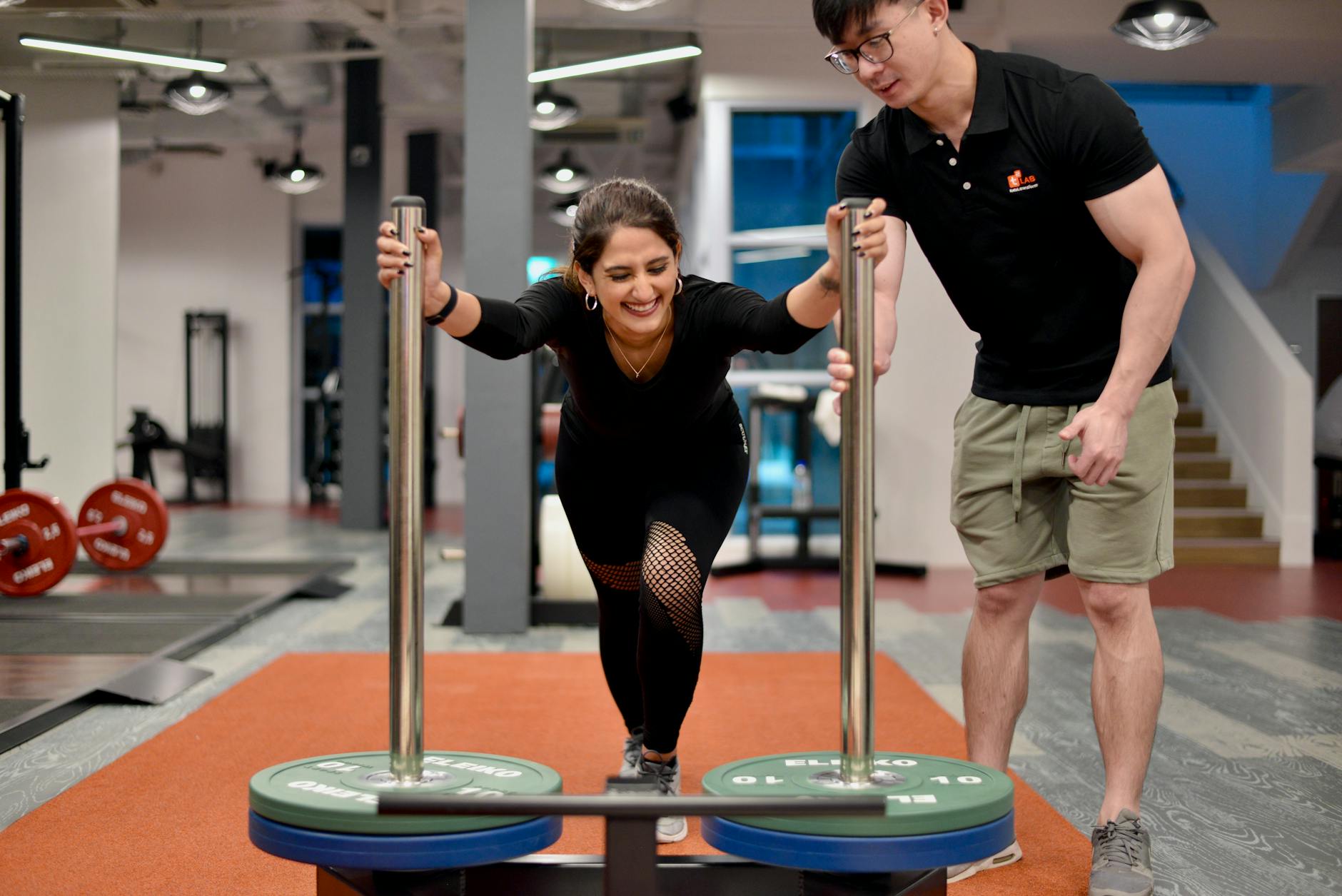
Research by health psychologist Eline Roordink at Vrije Universiteit Amsterdam shows that successful weight loss, and keeping the weight off, depends heavily on self-confidence and a social environment that supports healthy habits instead of making them harder. For professionals, there is often a third factor on top of that: chronic work stress.
Her research highlights the role of self-efficacy, or your confidence in your ability to stick with healthy behavior over time. It is one of the strongest predictors of whether someone falls back into old habits.
That is exactly the pattern District-S often sees in new members: people who have spent years trying to lose weight on their own, with mixed results. The missing piece usually is not willpower. It is a structured system that still works when work gets hectic.
Overweight and obesity remain a growing public health challenge. In the Netherlands, around half of the adult population is overweight, which is linked to a higher risk of chronic disease and a lower quality of life.
Fat loss vs. weight loss: the difference that changes everything
Improving body composition means lowering your body fat percentage while maintaining or increasing muscle mass. That is very different from simply losing weight.
Why the scale can be misleading
If you rely only on cardio and calorie restriction, the scale will usually go down, but you will often lose muscle along with fat. The result is a slower resting metabolism, which makes it harder to maintain your weight long term. That is why people who follow crash diets often lose weight quickly, only to regain it just as fast: muscle loss has slowed their metabolism. Strength training breaks that cycle by signaling to the body that muscle tissue is needed and worth keeping.
The role of strength training in fat loss
Research shows that people in a calorie deficit who combine strength training with adequate protein intake can preserve up to 95 percent of their muscle mass, while people who diet without training lose significantly more muscle alongside fat. The outcome is a better body composition: less fat, preserved muscle, and a metabolism that has not been dragged down by the dieting process.
Another major advantage of strength training is that, unlike cardio alone, it continues to increase calorie burn after the workout. In other words, your metabolism stays elevated, so your body keeps using energy more efficiently even when you are not exercising.
What the numbers say about body composition
Body fat percentage can decrease by 1 to 2 percent per month, while muscle mass increases. These changes can be tracked clearly with bio-impedance measurements, which give an objective view of progress. District-S uses these measurements as the starting point for every weight loss program, so progress is based on real data rather than the scale alone.
If you want more insight into how training and nutrition work together to improve body composition, read the article on protein, calories, and fat loss.
Try this yourself:
- Check whether your training plan includes strength training: at least 2 sessions per week focused on the major muscle groups
- Track more than body weight alone, such as waist and hip measurements, and body fat percentage if available
- If you have been training for weeks and the scale is not moving, ask yourself whether your clothes fit more loosely, because that is often a more reliable sign of fat loss
- Review your protein intake: during active fat loss, 1.6 to 2.2 grams per kilogram of body weight per day is a common guideline
Why work stress actively sabotages fat loss
This is the piece most weight loss programs leave out: stress is not a side issue. It is a direct barrier to fat loss.
Cortisol and fat storage
Sleep quality and stress levels are often underestimated. Getting seven to eight hours of sleep supports recovery and healthy hormone balance. Chronic stress raises cortisol levels and can slow progress, even when your training and nutrition look great on paper.
Losing weight can improve health in people who are overweight, but keeping the weight off is often the hard part. Many people experience a lapse, a temporary return to old habits, and after repeated lapses they may slide all the way back into their previous routine.
Burnout symptoms as a real risk factor
By combining different research methods, a broad and detailed picture emerged of the factors that influence relapse into less healthy behavior. Self-efficacy plays a major role in predicting whether someone returns to old habits.
For context, according to the RIVM, nearly one in five employees in the Netherlands reported burnout symptoms in 2024, the highest percentage ever recorded. If you are structurally overloaded, it is usually much harder to maintain a consistent training routine and make healthy food choices.
That is why District-S integrates mental coaching directly into its weight loss programs. Not as an optional extra, but as a core part of the process. You can read more about how that works in practice on the page about improving body composition with personal guidance.
Why a private training environment helps
A busy professional trains differently in a calm private gym than in a crowded commercial gym. No waiting for equipment, no distractions, and no awkwardness about asking for technical feedback. District-S has private gyms in multiple locations across Eindhoven for exactly that reason.
Try this yourself:
- If you consistently sleep less than 7 hours per night, treat that as a training obstacle, not a minor issue
- Build stress reduction into your weekly routine: 10 minutes of breathing work before a workout can reduce your cortisol spike
- If your setbacks always happen on the same day or in the same situation, make a specific plan for that situation in advance
- Talk to your personal trainer about work pressure and sleep, because that information matters when adjusting your program
What an effective weight loss program looks like in real life
Picture an operations director at a mid-sized manufacturing company, working 55 to 60 hours a week, with meetings scattered throughout the day and an unpredictable calendar. District-S sees profiles like this all the time.
The three pillars of the District-S weight loss program
The District-S approach is built on three pillars that work together at the same time:
1. Personalized strength training: two strength sessions per week, with a program that changes weekly to avoid plateaus, fully guided by a certified personal trainer
2. A nutrition plan matched to your training schedule: not a crash diet, but a protein-focused approach that fits your workweek, including practical advice for business lunches and work dinners
3. Mental coaching: structure-based interventions that help make training a lasting habit, even during demanding weeks
Consistent training, even when time is limited, works better than occasional bursts of intense effort. Twice a week for several months beats four times a week for a few weeks every time.
A realistic timeline in a structured program
| Phase | Period | Expected result |
|---|---|---|
| Adjustment | Week 1 to 4 | Better sleep, more energy, clothes start fitting differently |
| First milestone | Week 5 to 8 | Visible changes in body measurements, scale starts to move |
| Body composition change | Week 9 to 12 | Measurable difference in body fat percentage and muscle mass |
| Consolidation | Month 4 to 6 | New baseline becomes part of your routine |
Healthy weight loss typically falls between 0.5 and 1 kilogram per week. Faster loss often means losing muscle mass or water weight, which is not sustainable.
Nutrition as support, not punishment
Nutrition has a huge impact on how fast results show up. Good nutrition speeds up muscle recovery and supports energy levels. Poor eating habits can slow visible progress, even when training is solid. In the end, the combination of training and nutrition determines how quickly you reach your goals.
For busy professionals who struggle with meal planning, the article on losing weight responsibly after an injury also offers practical tips for combining recovery and nutrition.
Try this yourself:
- Set a minimum standard: if your schedule is too packed for two full sessions, do at least one shorter 30-minute session, because consistency matters more than perfection
- Use your first measurement in week 1 as a baseline, not a judgment: clear starting numbers are motivating throughout the process
- Discuss business obligations with your trainer in advance so your nutrition guidance can take them into account
- Schedule workouts as fixed appointments in your calendar, with the same priority as a client meeting
Why personal training works better for fat loss than going it alone
The biggest mistake people make when trying to lose weight is relying on willpower instead of structure. Research shows that people with guidance lose weight faster and more consistently than those training on their own, because they have structure, feedback, and accountability.
Accountability is often the deciding factor
A personal trainer at District-S does more than coach the workout itself. They also monitor nutrition, sleep patterns, and how you are doing mentally that week. If a session is about to get bumped because a meeting ran over, there is an immediate backup plan. That is the difference between real coaching and an app or a standard gym membership.
Correcting mistakes before they become injuries
Strength training is generally a safe form of exercise. But as with any physical training, there are risks. Poor technique, loads that are too heavy, or progressing too quickly can all increase the likelihood of overuse and injury, especially if you are relatively new to training. Immediate technique correction is one of the most underrated benefits of one-to-one coaching.
The most popular sport, but low activity levels overall
Participants in combined lifestyle interventions lost an average of 5 percent of their body weight by the end of the program, while waist circumference dropped by nearly 5 percent on average. Quality of life also improved significantly, rising by 13 points on a scale from 0 to 100.
At the same time, RIVM/VZinfo data shows that in 2025, only 46.1 percent of Dutch adults aged 18 and over met the national physical activity guidelines, which recommend at least 150 minutes of moderate-intensity activity per week. The intention to exercise is there. The structure often is not.
That is exactly the gap District-S fills: more than a gym, it is a complete coaching system. Explore the options at district-s.nl and book a free trial session with no obligation.
Try this yourself:
- Ask yourself: have I consistently trained twice a week over the past three months? If not, the issue may be the system, not your motivation
- Compare your training results over 8 weeks: if nothing was measured, there is no real proof of progress
- A free trial session at District-S gives you a clear sense of how guided training differs from working out alone
- If you have lost weight before and gained it all back, ask whether your method included a behavior component or just diet and cardio
Frequently asked questions
How many times a week should I train to lose weight?
Training frequency matters less than most people think. For most people, two well-executed strength training sessions per week are enough to build muscle and raise metabolism over time. More is not always better: muscles grow during recovery, not during the workout itself. For busy professionals, consistency over the long run matters more than squeezing in the highest possible number of sessions for a few weeks.
What is the difference between losing weight and improving body composition?
Improving body composition means reducing body fat while maintaining or increasing muscle mass, whereas losing weight simply means your total body weight goes down. On the scale, the result may look modest, but in the mirror and in the way your clothes fit, the difference can be dramatic. If you focus only on body weight, you miss whether the change came from fat or muscle, and that makes all the difference long term.
How does District-S help busy professionals lose weight?
District-S combines one-to-one personal training with personalized nutrition plans and mental coaching in a private gym setting across multiple Eindhoven locations. The approach is specifically designed around a busy schedule: workouts are short and efficient, nutrition advice fits real work routines and business obligations, and the free trial session makes it easy to experience the concept without any membership commitment.
Why doesn’t a crash diet work for long-term fat loss?
Crash diets can lead to rapid weight loss, but they also tend to cause muscle loss, which slows your resting metabolism. People who combine a calorie deficit with strength training and sufficient protein usually preserve the vast majority of their muscle mass, while people who only diet without training lose much more muscle along with fat. The result is a better body composition and a metabolism that has not been compromised by the dieting process. The yo-yo effect of crash dieting is not bad luck; it is a direct metabolic consequence.
What results are realistic in a guided weight loss program?
Measurable changes in the way clothes fit often become noticeable within 3 to 5 weeks. Between weeks 5 and 8, visible body composition changes typically appear, along with more definition and a leaner feel, and the scale may start to move. By weeks 9 to 12, there is usually a clear and measurable difference in muscle mass and body fat percentage. In practice, people with guidance get more consistent results than those training on their own, because structure and feedback help prevent drop-off.
Conclusion
Losing weight as a busy professional is not about trying harder. It is about using the right strategy. Research shows that self-efficacy plays a major role in predicting whether someone falls back into old habits. In simple terms, that means confidence in your ability to maintain healthy behavior over time. And that confidence is built through measurable progress, not good intentions.
The combination of strength training, personalized nutrition, and mental coaching leads to better long-term body composition than dieting and cardio alone. It is not a quick fix. It is a method that still holds up when life gets busy.
For professionals in Eindhoven who want to get started, District-S offers a free trial session at multiple locations. No obligations, just immediate insight into what a guided program could deliver for your specific situation. For more detail, read about the District-S approach and program options to see what premium coaching looks like in practice.
Sources
- CBS (2025) — Cbs
- RIVM — Rivm
- RIVM/VZinfo-data — Vzinfo
- 62 procent van volwassenen tevreden met eigen gewicht — Centraal Bureau voor de Statistiek (CBS)
- Obesitas afgelopen 40 jaar verdrievoudigd — Centraal Bureau voor de Statistiek (CBS)
- Bewegen | Volwassenen | Volksgezondheid en Zorg — RIVM / VZinfo.nl
- Burn-out klachten | RIVM — RIVM
- Eigenwaarde en sociale omgeving cruciaal voor succesvol afvallen — Vrije Universiteit Amsterdam