
Quick summary
Smart training for entrepreneurs isn’t about spending more time in the gym. It’s about getting the most out of every session. According to TNO (2024), working people in the Netherlands sit for an average of 8.9 hours per workday, contributing to an estimated €1.2 billion in annual healthcare costs. For entrepreneurs, the choice between training alone and working with a coach largely determines whether those workout hours actually pay off in energy, focus, and productivity.
- More than half of people in the Netherlands do not meet national physical activity guidelines (Kenniscentrum Sport en Bewegen, 2024)
- Entrepreneurs in desk-based roles face increased health risks, including cardiovascular disease and type 2 diabetes
- Targeted personal training typically leads to measurable physical results within 4 to 8 weeks
- A private gym removes waiting time and unnecessary distractions, two costly inefficiencies busy entrepreneurs can’t afford
- In Eindhoven, District-S combines one-on-one coaching, tailored nutrition plans, and mental coaching in private gyms at Strijp-S and the city center
Why entrepreneurs often quit traditional gyms
You block out time to train. Ten minutes in the car, time to park, the changing room, waiting for equipment, then running into someone you know and making small talk. Before you know it, what was supposed to be a one-hour workout has turned into two hours lost. That’s the pattern District-S sees again and again with new members who previously trained at large commercial gyms.
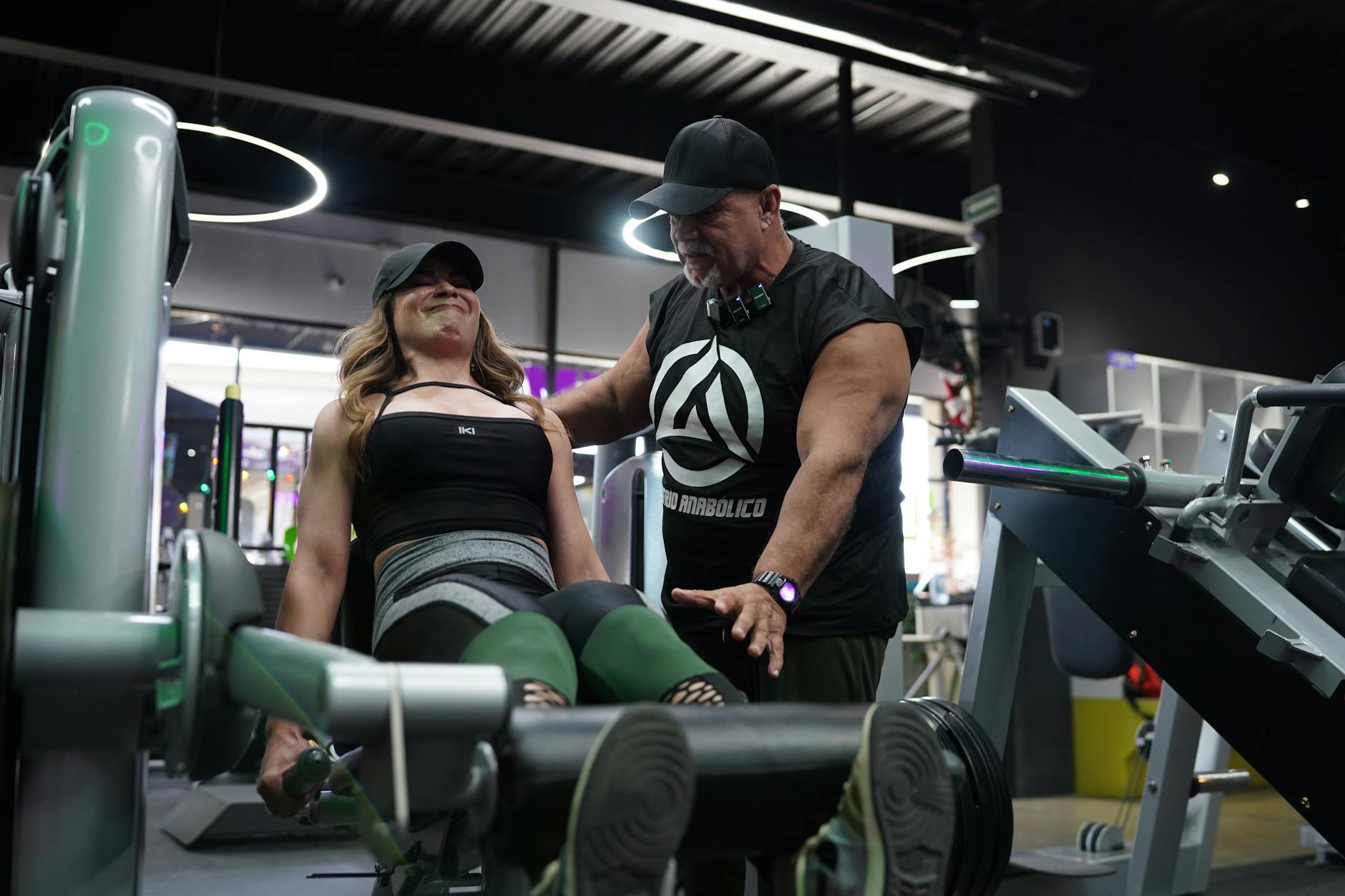
The time problem runs deeper than most people think
According to TNO research (2024), working people in the Netherlands sit for an average of 8.9 hours per workday, with more than half of that time happening during working hours. On top of that, the Netherlands ranks among Europe’s leaders in sedentary behavior: nearly 3.9 million employees – roughly 48 percent of the workforce – sit for 6 hours or more each day. For entrepreneurs in sectors such as financial services and IT, those numbers are often even higher.
That means the average entrepreneur is already starting from a physical deficit. A half-hearted workout routine – say, showing up at a big gym twice a month – won’t offset that. In fact, inconsistent and interrupted training is more likely to lead to injuries than real progress.
The real issue: no structure, no progress
Many entrepreneurs simply don’t know how to use their limited time as efficiently as possible. They’re unsure which exercises match their goals, they don’t pay enough attention to recovery, and they lack the external accountability that drives consistency. The answer isn’t finding more spare time. It’s following a system that makes every minute count.
That’s exactly why smart training for entrepreneurs as part of a small group or one-on-one approach consistently outperforms ad hoc sessions in a crowded gym.
What you can do yourself:
- Add up how many hours you actually trained over the past month, including travel time
- Compare that to your target: if you’re below 6 sessions per month, your current approach probably isn’t sustainable
- Write down how much time you lose per session to waiting, extra travel, or social distractions
- If you’re losing more than 30 minutes per session, a private gym with fixed time slots is usually the more efficient option
Private gym vs. traditional gym: an honest comparison
Your training environment plays a major role in whether your goals are realistic within the schedule of a busy entrepreneur. Below is a comparison of the factors that matter most.
| Aspect | Private gym (District-S approach) | Traditional gym |
|---|---|---|
| Waiting time per session | Usually 0 minutes (reserved in advance) | Often 5 to 20 minutes during busy hours |
| Coaching | One-on-one or small group, fully focused | Independent training or occasional instruction |
| Programming | Adjusted weekly to match your goals | Fixed routines, rarely updated |
| Measurability | Regular progress tracking included | Self-tracked or not tracked at all |
| Recovery and nutrition | Built into the program | Outside the offer, left to you |
| Weekly time investment | Usually 1 to 2 sessions of 45 to 60 minutes | Variable, often without a clear plan |
Why tracking matters for entrepreneurs
Entrepreneurs think in terms of return. Training is no different. The difference between training with and without measurement is a bit like running a business with or without financial reporting: you may be putting in the work, but you have no clear idea whether you’re moving forward.
District-S uses regular progress tracking as a standard part of every program. Not as a formality, but as a way to steer results. If strength gains or body composition improvements stall, the trainer adjusts the plan right away. That’s fundamentally different from repeating the same routine for years and hoping it suddenly starts working.
How environment affects consistency
A private gym without crowds, queues, or distractions lowers the barrier to actually showing up. That may sound like a small detail, but behaviorally it matters a lot: the less friction there is in a habit, the more likely you are to stick with it. For an entrepreneur debating whether to train on a packed day, the calm environment of a private gym can make all the difference.
What you can do yourself:
- Ask yourself: how often do you skip training because the gym is too crowded or too far away?
- If you miss more than 2 sessions a month for logistical reasons, consider an approach with fixed time slots and shorter travel time
- Review your progress over the past 3 months: have you clearly improved in strength, fitness, or energy? If not, it’s time to rethink your setup
How much training is enough for a busy entrepreneur?
This is the question District-S hears most often during introductory calls. The answer is less glamorous than many people hope: less than you think, but far more consistent than what you’re probably doing now.
The frequency that actually works
In practice, two well-coached sessions per week are enough for most entrepreneurs to see measurable improvements in strength, fitness, and body composition. Even one properly structured session per week can be enough to prevent fitness loss and maintain a baseline, as long as the intensity is right.
The Dutch Health Council recommends at least 2.5 hours of moderate-intensity physical activity per week, spread across multiple days. According to Kenniscentrum Sport en Bewegen, only 46 percent of people in the Netherlands aged 4 and older met these guidelines in 2024, and that figure has stayed almost unchanged for years. Higher-educated groups score slightly better: according to CBS (2023), 49 percent of adults aged 25+ with a college or university degree met the guidelines, and 65 percent exercised weekly. Even so, nearly half still fall short.
When more is not better
A common mistake among motivated entrepreneurs is going all in during a quiet stretch – scheduling five sessions a week – only to quit completely three months later. For most people, training five times a week while running a business just isn’t realistic over the long term.
District-S sees this clearly when coaching entrepreneurs: one to two sessions per week, maintained consistently for 12 weeks, produces better results than an intense but short-lived sprint. Real behavior change comes from repetition, not bursts of motivation.
What you can do yourself:
- Decide what you can realistically commit to each week, based on a normal busy week, not your ideal one
- Schedule no more than two sessions as fixed appointments, not optional plans
- Track whether you hit that frequency for 12 weeks: completing more than 80 percent of planned sessions is usually the threshold for measurable results
- Only add a third session once you’ve consistently maintained two sessions per week for at least three months
How nutrition and mental coaching support training success
Many entrepreneurs focus only on the workout itself. That’s understandable, but it’s also why progress often plateaus after a few weeks. Training is the stimulus. Recovery, nutrition, and mental focus determine whether that stimulus turns into results.
Nutrition as a performance tool, not a diet
A training plan without a nutrition strategy is like a business strategy without execution. Your energy for tough sessions, your recovery afterward, and your long-term body composition are all strongly influenced by what you eat. District-S builds tailored nutrition plans into every program, matched to training frequency, physique goals, and the entrepreneur’s daily routine.
If you want to explore that further, meal prep for entrepreneurs with a busy schedule explains how to get your nutrition under control without losing extra time.
Mental coaching: the missing link for many entrepreneurs
Stress, poor sleep, and high mental workload are everyday realities for entrepreneurs. They also directly affect how effective training is: a bad night of sleep or a heavy workweek increases injury risk and reduces recovery capacity. A personal trainer who notices that and adjusts the session accordingly delivers far more value than one who blindly follows the original plan.
District-S combines physical one-on-one coaching with mental coaching as an integrated part of every program. Not as an add-on, but as a core element. That’s what makes personal training in Eindhoven different from a standard supervised workout.
What you can do yourself:
- Check whether your nutrition consistently includes enough protein: a practical guideline is usually 1.6 to 2.0 grams per kilogram of body weight per day when training regularly
- Track for one week how your sleep quality affects your training performance: if you sleep less than 6 hours on more than two nights per week, discuss it with your trainer
- Ask your trainer to adapt your session during a heavy workweek rather than pushing through the same intensity regardless
Which approach fits you as an entrepreneur?
Not every entrepreneur starts from the same place. The right approach depends on an honest look at three things: available time, current fitness level, and the type of result you want.
If you haven’t trained consistently for at least a year
Start with one coached session per week in a private gym setting. Your first priority is technique and rebuilding the habit, not intensity. For this, District-S offers a back-in-shape starter package aimed at entrepreneurs who want to rebuild after a longer break. The free trial session is an easy first step if you want to experience the approach without committing right away.
If you already train but aren’t seeing progress
This is the most common pattern District-S sees among new members in Eindhoven switching from a traditional gym. They’ve been training for months, but their body composition barely changes and their energy levels don’t improve. The cause is almost always a combination of suboptimal programming, poor recovery, and nutrition that doesn’t match training demands.
In that case, a full program with weekly-adjusted training plans, nutrition guidance, and measurable goals is the most efficient route. In practice, two one-on-one sessions per week usually lead to noticeable changes in strength and energy within 8 to 12 weeks.
What you can do yourself:
- Answer these three questions honestly: Have I clearly gotten stronger over the past three months? Has my energy improved? Have I been consistent?
- If you answer “no” to two or more, review your approach rather than blaming your willpower
- Book a free trial session at District-S to experience what coached training in a private gym feels like, then compare it to your current routine
Frequently asked questions
How many times a week should I train if I’m an entrepreneur with a busy schedule?
Two coached sessions per week is the most effective and realistic frequency for most entrepreneurs. One well-structured session can already be enough to stop fitness decline, but measurable progress in strength and body composition usually requires two. Consistency over at least 12 weeks matters more than occasional high-intensity efforts.
What’s the difference between a private gym and a traditional gym?
A private gym gives you a reserved training space without waiting times, distractions, or the usual social noise, which saves busy entrepreneurs time straight away. In a traditional gym, you usually train independently and without systematic progress tracking, which makes it easier for progress to stall and inefficient routines to creep in. District-S combines the private setting with one-on-one coaching, weekly-adjusted programming, and integrated nutrition coaching.
How quickly will I see results with personal training as an entrepreneur?
The first noticeable results – such as better energy and improved sleep – usually show up within one to two weeks of starting focused training. Visible physical changes in strength and body composition are typically measurable after 6 to 12 weeks of consistent training. The exact timeline depends on your starting point, training frequency, nutrition, and recovery quality.
How does District-S specifically help entrepreneurs with busy schedules?
District-S offers flexible memberships with one or two sessions per week, fixed time slots in private gyms at Strijp-S and the city center in Eindhoven, and a coaching approach where the trainer adapts the program to your current workload and energy levels. The combination of training, tailored nutrition plans, and mental coaching is designed to produce results without requiring a complete overhaul of your daily schedule.
What does inefficient or inconsistent training really cost an entrepreneur?
The direct costs of prolonged sitting are substantial: TNO estimates that the annual healthcare costs linked to long periods of sitting amount to an estimated €1.2 billion for the Dutch population as a whole. For individual entrepreneurs, unhealthy sedentary habits usually show up as reduced focus, greater sensitivity to stress, and a higher risk of burnout or physical complaints forcing time off. Investing in targeted training is therefore not just a health choice, but a business decision.
Conclusion
Entrepreneurs don’t usually lack motivation. They lack a system. The data is clear: people in the Netherlands sit too much, more than half the population does not meet physical activity guidelines, and the highly educated professionals who sit the most still tend to move too little.
For busy entrepreneurs, the choice between a traditional gym and a private gym with one-on-one coaching isn’t really about preference. It’s about return on time and effort. Every minute lost to waiting, unnecessary repetition, or lack of progress is a minute you don’t get back.
At Strijp-S and in Eindhoven city center, District-S has built an approach specifically around that problem: structured, measurable training in a private setting, supported by nutrition guidance and mental coaching. The free trial session is the most direct way to find out whether this approach fits your schedule and goals. You can learn more about how District-S delivers premium personal training for entrepreneurs on the website.
Would you like to learn how we can assist you with personal training?
Sources
- het CBS (2023) — het CBS
- TNO (2024) — Tno
- bijna 3,9 miljoen werknemers — Fysiekebelasting
- Volgens het Kenniscentrum Sport en Bewegen — Kenniscentrumsportenbewegen
- volgens het CBS (2023) — Cbs
- Zittijd onder werkenden is zorgwekkend — TNO
- Nieuwe factsheets bekend over fysieke arbeidsbelasting, beeldschermwerk en zitten tijdens het werk — TNO Fysieke Belasting
- Beweegcijfers 2024 bekend: conclusie blijft zorgwekkend — Kenniscentrum Sport en Bewegen